Electric Team

A Fantasy Adventure Web Comic
  • Home
  • Archive
  • The Cast
  • About the Creators
  • Contact
  • Order Our Comics!

Ten Notes on Page 248

by leighton on October 31, 2018
Posted In: Uncategorized

Page 248 is here! Make sure you read it, then dive into the notes below.

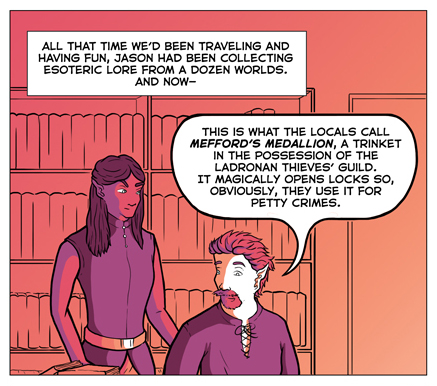
1. This is our wordiest page ever. I usually try to follow a rule that I got from Alan Moore, which says you should never have more than 35 words in one panel, and never more than 25 words in one word balloon. On this page, I wanted to commit to the exposition, so I broke the rule multiple times. And I’m not sorry.

2. I mentioned earlier that it took me forever to figure out the plot for this page. The reason why is that I had to work out the mechanics of how Jason Occult gets this magic cloak. I wanted him to come up with a clever plan, based on his research, that would allow him to do something almost impossible. I also wanted a plan that you could believe no one else had ever come up with, because they’d never noticed a key detail.

3. In case it’s not clear, the key detail is that there’s an unbreakable lock, but then there’s a magic artifact that can open any lock, and no one’s aware of just how powerful that artifact is.

4. Jason and Brianna are currently living in the city of Ladrona, in the world of Kreos, which was created by Steve Johnson and is used here with his kind permission.

5. Ladrona was inspired by the greatest fantasy city of all, Lankhmar, as seen in Fritz Leiber’s Fafhrd and the Gray Mouser stories. Someday I’ll write an essay about how tragically unappreciated Leiber is, but for now I’ll just urge you to try one of his books, like Swords Against Wizardry.

6. Mefford’s Medallion is named after Eddie Mefford, who played in Steve’s Kreos game back in the day. I thought of him because I wanted a name that started with “M,” to provide alliteration.

7. Xöthma-Ghül, the “Crepuscular City,” was invented by Josh Burnett, and is developed in the pages of his fine publication Crepuscular. Josh was kind enough to allow me to reference it here. Josh also named the Amulet of Othyg-Zoag; he tells me that Othyg-Zoag is the Opener of Ways, the god of hyperspace and momentum. It’s all canon, folks.

8. Xöthma-Ghül is on the world that the people of Swann Castle have labelled “Orange Willow.” Kreos is Orange Elm, and Brianna is from Orange Maple. The Orange branch seems to be all fantasy worlds. Vekros, which is Orange Pine, is what you might call a sword-and-sorcery setting.

9. The world that Xöthma-Ghül inhabits is a higher-magic world than Kreos, so it makes sense that, once the Amulet of Othyg-Zoag ended up on Kreos, no one considered that it might have cosmic powers.

10. Abi named the Vault of Varlo. I didn’t describe it at all in the script, in the hope that Sam would come up with something cool and weird, and guess what! She did!
Share this:

  • Share on Facebook (Opens in new window) Facebook
  • Share on X (Opens in new window) X
  • Share on Tumblr (Opens in new window) Tumblr
  • Share on Pinterest (Opens in new window) Pinterest
  • Share on Reddit (Opens in new window) Reddit
  • Email a link to a friend (Opens in new window) Email

Page 248 is here!

by leighton on October 30, 2018
Posted In: Uncategorized

We missed last week, but we’re back, and we should be stay on schedule now.

Check out page 248! It is delightful!


Thanks to Steve Johnson for the use of Kreos, and thanks to Josh Burnett for the use of Xothma-Ghul.

Share this:

  • Share on Facebook (Opens in new window) Facebook
  • Share on X (Opens in new window) X
  • Share on Tumblr (Opens in new window) Tumblr
  • Share on Pinterest (Opens in new window) Pinterest
  • Share on Reddit (Opens in new window) Reddit
  • Email a link to a friend (Opens in new window) Email

10 Things You Maybe Don’t Know About the Origins of Hex Games

by leighton on October 20, 2018
Posted In: Uncategorized

Last weekend the staff of Hex Games, including me, went to Archon 42 in Collinsville, where we celebrated the 20th anniversary of the publication of QAGS. This occasion inspired lots of reminiscing about the early days of Hex, which in turn inspired this list.

In the early days of Hex, we wanted to build a mythology around ourselves, so we wrote staff bios that were filled with lies, and we wrote multiple, contradictory accounts of how the company got started. It was difficult to figure out the truth; we thought this was hilarious, but people who just wanted to know who we were found it annoying. Maybe they had a point. We’re older now, so all ten items in this list are true.


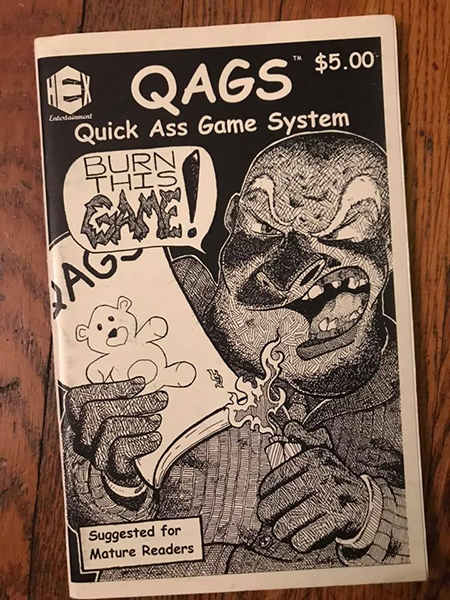
1. In 1997 Scott, a college student who would be graduating in a few months, had the idea that he and his friends should work together to publish their various creative endeavors. Scott’s original pitch was that he, Steve, Dale, and me would form a company called Upstart. It turned out that name had already been taken, so instead we founded a company called Hex Entertainment. The idea was that we would start with games, and branch out into comics and other media. For our first release, we decided on QAGS, a game system Steve had created, because we thought it would be quick and easy to write.

2. Writing QAGS took a year. But it was a very productive year, in which Steve and I learned how to sit down and, sentence by sentence, co-write a book. Dale was there at the beginning, but soon drifted away; this wasn’t a surprise, since he lived in another city. Lots of our friends chipped in, in one way or another, popping into Steve’s apartment and hanging out while we labored over the text. After we finished the first draft, we shared it, got feedback, and revised.

3. When we decided to write QAGS, we felt like we could probably fit all the rules on a single sheet of paper, so we had to find some way to expand it into a book. We settled on including lots of jokes. Back then many RPG books were written in a dry, informative style; we wanted something that would keep the reader entertained. Honestly, though, we overdid it—we would actually say things like, “There’s a paragraph here with no jokes, we need to add one in.” The finished text had so many jokes that they got in the way of understanding the (simple) rules.

4. In QAGS, you want to roll high without going over. It’s not that you want to roll as close to your number as possible; percentages don’t matter. The higher the number of your success, the better. This has often been misunderstood.

5. The artwork in QAGS comes mostly from a couple of pages of random drawings that Dale and I did, some of which was intended for publication and some of which was not. We weren’t paying for art, though, so we took what we could get. Steve’s then-roommate Robert gave us a stack of drawings. Robert was young and looking to get published, and we were happy to give him his first big break. Shortly after QAGS came out, Robert decided he was more interested in writing than drawing. He went on to create a comic book series The Walking Dead which was, in some ways, even more successful than QAGS.

6. Early on, we bought a teddy bear, named him Mr. Pookums, and made him the president of Hex Games. Just like all the successful companies do.

7. Dale drew the QAGS cover. We recruited a fellow we gamed with named Robert (not the Walking Dead guy) to do the layout. He was an art teacher, and for some reason we met in his classroom, where we huddled around his computer and watched him lay out the book. We chose Comic Sans for the font, because it was the 90s, and we didn’t know any better. Robert also designed and drew the Hex logo, which is still in use to this day.

8. While we were working on the book, we were also marketing QAGS. We set up a website, with the extremely catchy address http://www.mindspring.com/~sejohnson, and filled it with in-jokes and nonsense. So much nonsense. Steve and I ran QAGS games at local conventions. Some of the earliest games we ran were Scooby-Doo Meets the X-Files, Dukes of Hazzard Meets the Invisibles, ViewAskewniverse, and Qerth. The games went really well, which motivated us to get the book done.

9. QAGS was a charming black-and-white digest-sized book, that looks like we made it at Kinko’s, but we used a local printing company. After all our hard work it was amazing to finally have the finished product in our hands. We released it in 1998, selling it at local stores in Lexington, and through the website. There was a lot of excited talk about this new “e-commerce,” back then. Sales were pretty good . . . good enough to print up more books, which was what we had hoped for.


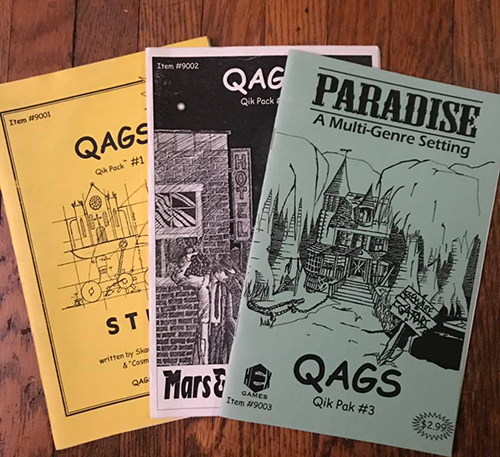
10. We decided to call our supplements Qik Paks. Scott and our friend Ray co-wrote the first Qik Pak, called Stuff. This was followed by Mars and Venus at War, by me, and Paradise, by Steve. Stuff was an equipment guide, Paradise was a setting guide and Mars and Venuswas an adventure. I didn’t realize, until I looked just now, that all three of those Qik Paks came out in 2000. That means we released QAGS in 1998, took a year off, and then released books every year since. To date, Hex has released over 60 products.

Share this:

  • Share on Facebook (Opens in new window) Facebook
  • Share on X (Opens in new window) X
  • Share on Tumblr (Opens in new window) Tumblr
  • Share on Pinterest (Opens in new window) Pinterest
  • Share on Reddit (Opens in new window) Reddit
  • Email a link to a friend (Opens in new window) Email
  • Page 12 of 73
  • « First
  • «
  • 10
  • 11
  • 12
  • 13
  • 14
  • »
  • Last »

What Is This?

The Electric Team is a fantasy adventure comic for readers of all ages, with new installments every Tuesday.

The Electric Team is brought to you by Leighton Connor, Abigail Connor, and Samantha Albert.

Become a Patron!
May 2026
M T W T F S S
« Dec    
 123
45678910
11121314151617
18192021222324
25262728293031
  • Home
  • Archive
  • The Cast
  • About the Creators
  • Contact
  • Order Our Comics!

©2015-2020 Electric Team | Powered by WordPress with ComicPress | Subscribe: RSS | Back to Top ↑